Engineering a Miniaturized Catheter Platform for Controlled Filter Deployment
Client Need & Project Overview
In vascular intervention, solving one clinical problem can sometimes introduce another. Traditional vascular filters help prevent pulmonary embolisms caused by deep vein thrombosis, but many permanent filters are never removed, exposing patients to long-term complications including migration and strut fracture.
A startup client approached NOVO Engineering to help develop a different approach: a resorbable vascular filter delivered through a highly specialized catheter deployment system.
The device would be deployed using a catheter-based procedure similar in principle to balloon catheter stent placement. The system needed to navigate through the vasculature over a guide wire, position the filter accurately under fluoroscopic imaging, expand the filter using a balloon, confirm apposition against the vessel wall, and safely release the implant before catheter removal.
NOVO was engaged to develop the complete catheter delivery system, including the catheter architecture, miniature deployment mechanisms, handpiece controls, and supporting prototype manufacturing processes for preclinical testing.
Traditional filters, such as inferior vena cava (IVC) filters, are typically constructed from metal and are often intended for eventual removal once the risk of pulmonary embolism has subsided. However, many filters are never retrieved, potentially increasing the risk of complications such as strut fracture or device migration. The client’s resorbable polymer approach aimed to eliminate the need for a secondary removal procedure while reducing the long-term risks associated with permanent implants.
Key Engineering Challenges & Solutions
| Challenge | NOVO’s Solution |
|---|---|
| Delivering a complex system within a 16Fr introducer | Developed a seven-layer concentric catheter architecture that packaged the guide wire, balloon, sheath, filter, multi-lumen tubing, and deployment mechanisms into a highly constrained form factor. |
| Maintaining secure filter retention during deployment | Engineered a miniature mechanical retention mechanism capable of securely holding the filter during positioning and balloon inflation. |
| Preventing premature release of the filter | Designed a remotely actuated release mechanism operated from the handpiece using a controlled thumb motion and supported by mechanical interlocks. |
| Confirming filter apposition prior to release | Incorporated radiopaque markers to provide fluoroscopic verification of filter positioning and vessel wall apposition before balloon deflation and release. |
| Achieving sufficient flexibility and deliverability | Developed proprietary methods to improve flexibility in intermediate catheter layers while maintaining structural integrity and pushability. |
| Supporting procedural usability and safety | Integrated balloon inflation controls, pressure monitoring, overpressure protection, user feedback indicators, and sequencing interlocks into the handheld system. |
Technical Innovations & System Design
Miniaturized Multi-Layer Catheter Architecture
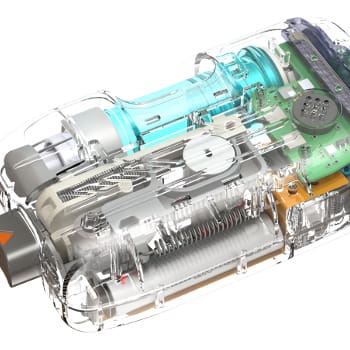
One of the primary engineering challenges was miniaturization. The catheter system required seven concentric functional layers, excluding the introducer itself, while still maintaining the flexibility, strength, and deliverability needed for vascular navigation.
The system incorporated:
- A guide wire path
- Multi-lumen tubing
- Balloon components
- Filter containment structures
- Sheath components
- Two separate mechanism layers
All components had to function reliably within the dimensional constraints of a 16Fr introducer system. Specialized fabrication and assembly methods were developed to support the miniature architecture and maintain tolerances appropriate for the reduced scale.
This type of systems-level miniaturization has become increasingly important across many catheter-based therapies and minimally invasive devices. NOVO’s work anticipated many of the engineering priorities now driving next-generation minimally invasive devices.
Mechanical Retention & Controlled Deployment
Blood flow within the vessel introduced significant hydrodynamic forces during filter placement, creating a critical need for secure filter retention prior to deployment. A premature release could allow the filter to migrate into the lungs and potentially cause embolic complications.
NOVO developed a miniature retention mechanism capable of mechanically securing the filter throughout positioning and balloon expansion. Once apposition against the vessel wall was verified, the release mechanism could be actuated remotely from the handpiece using a simple thumb-operated motion.
Mechanical interlocks were incorporated to prevent out-of-sequence operation and improve procedural safety.
Deliverability, Flexibility & Performance Testing
Achieving sufficient flexibility without compromising catheter performance presented another major technical hurdle. As catheter components become smaller, maintaining the correct balance between stiffness, flexibility, and strength becomes increasingly difficult.
NOVO developed proprietary methods to increase flexibility in the catheter’s intermediate layers, allowing the system to navigate relatively small bend radii within the femoral artery with minimal insertion force.
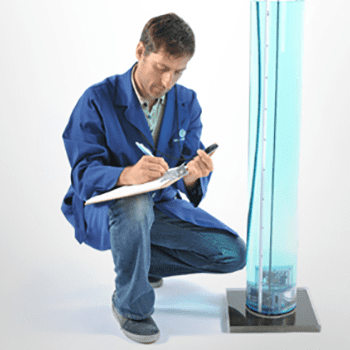
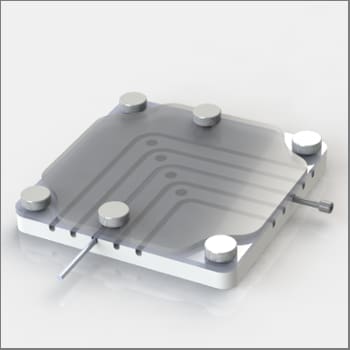
To evaluate performance, NOVO also developed a dedicated fixture for measuring pushability and trackability, two critical characteristics that together define catheter deliverability.
Imaging & Procedural Verification
The deployment system incorporated radiopaque markers that enabled physicians to visualize filter positioning under fluoroscopic imaging and verify proper apposition against the vessel wall prior to release.
This emphasis on procedural visualization and deployment confirmation reflects the broader evolution of image-guided minimally invasive procedures, where precision and deployment confidence are critical to procedural success.
Handpiece Design & User Interaction
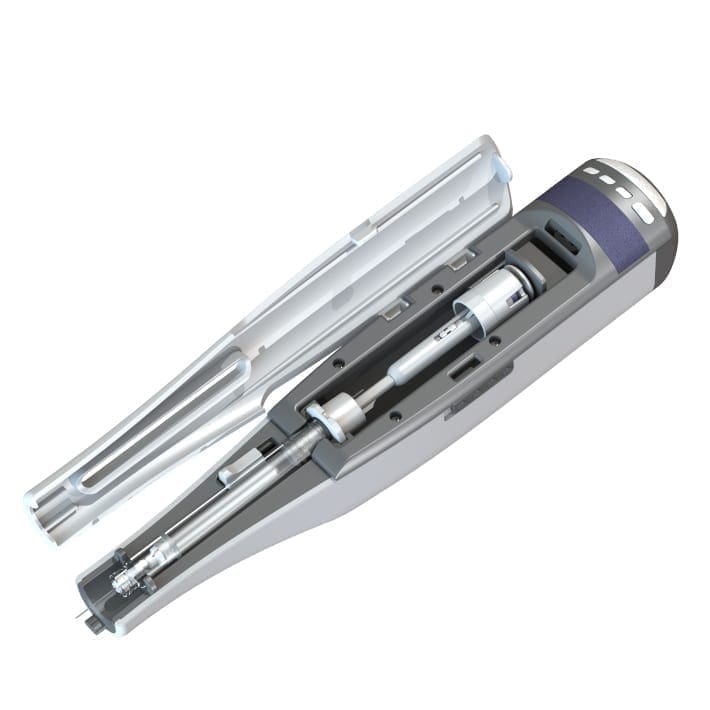
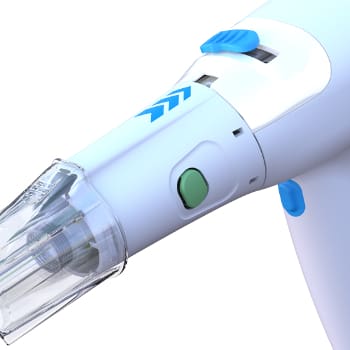
The handheld deployment system integrated multiple procedural functions into a single-use mechanical device, including:
- Balloon inflation controls
- Pressure gauge monitoring
- Integrated overpressure protection
- Safety interlocks
- Fill and flush ports
- Step-by-step user feedback indicators
- Sheath retraction controls
The final system was entirely mechanical and designed to support intuitive procedural workflows while minimizing the risk of user error during deployment.
Good Laboratory Practices & Prototype Manufacturing
To support testing for good laboratory practices, NOVO completed two pilot manufacturing runs of the deployment system. This work included assembly and packaging of the devices for sterilization and testing.
NOVO also collaborated with the packaging vendor on custom packaging designs for the catheter system. The packaged prototypes were sterilized using ethylene oxide prior to preliminary device testing conducted by the client.
The resulting systems performed well during early evaluations.
Results & Impact
NOVO delivered a fully functional catheter delivery system prototype for a resorbable vascular filter, addressing the complex mechanical, dimensional, and usability challenges associated with minimally invasive vascular delivery.
The final handheld deployment system combined:
- A multi-layer catheter architecture
- Controlled mechanical deployment
- Radiographic verification features
- Safety interlocks
- Balloon inflation controls
- Deliverability optimization
- User feedback mechanisms
Today, bioresorbable technologies and minimally invasive delivery systems remain important areas of focus in vascular intervention. Many of the engineering priorities explored in this project, including miniaturization, controlled deployment, and temporary implant strategies, remain important areas of focus in catheter-based device development.
Why NOVO Engineering?
Complex catheter-based systems require more than component-level engineering. They demand a coordinated approach that balances miniaturization, mechanical reliability, procedural usability, manufacturability, and clinical workflow considerations within a tightly constrained system architecture.
NOVO Engineering brought together expertise in miniature mechanisms, catheter system design, usability engineering, fabrication methods, and prototype manufacturing to help transform an early-stage concept into a functional deployment platform for preclinical evaluation.
Projects like this demonstrate NOVO’s ability to solve multidisciplinary engineering challenges that sit at the intersection of device innovation, procedural safety, and minimally invasive therapy development.
Let’s Talk About Your Project
If you’re developing a next-generation catheter system, implantable device, or minimally invasive therapy platform, NOVO can help. Contact us to discuss your engineering and product development goals.