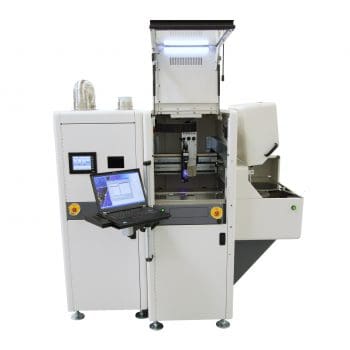
Automating the Cleaning of High-Aspect-Ratio Microplates for High-Throughput Screening

Client Need & Project Overview
As the life sciences industry accelerated toward higher-throughput discovery workflows, laboratories began adopting increasingly automated systems to support scale, repeatability, and contamination control. Diversa, a leader in microbial discovery, developed the GigaMatrix screening platform, also engineered in partnership with NOVO, which relied on ultra-high-density microplates containing up to one million high-aspect-ratio wells per 3 x 5-inch plate.
To reuse these plates in downstream assays, they needed to be cleaned according to a tightly controlled protocol that manual processes could not achieve at the required throughput or consistency. Diversa sought a fully automated microplate cleaning robot that could execute a multi-step wash and dry sequence, avoid damage to the fragile labware, and achieve a throughput of six plates per hour.
The project required industrializing a novel cleaning process and integrating robotics, fluidics, and automation into a cohesive system. This type of integrated approach has since become central to modern laboratory automation, where robotic transport and multi-stage workflows are now foundational elements of high-throughput research.
Key Engineering Challenges & Solutions
| Challenge | NOVO’s Solution |
|---|---|
| Cleaning extremely high-aspect-ratio wells: Capillary forces prevented effective cleaning using immersion or low-pressure methods. | Developed a multi-stage sequence combining pressure washing, ultrasonic cleaning, and vacuum drying to fully clear narrow, deep wells. |
| Protecting fragile microplate surfaces: Rigid contact or misalignment could easily damage the expensive plates. | Integrated a six-axis robotic arm with custom grippers and non-contact handling methods that prevented any rigid contact with plate surfaces. |
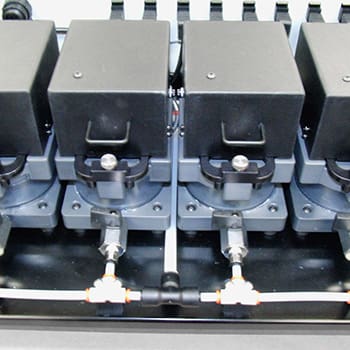
| Managing high-pressure fluid systems: High-volume spray and circulation required reliable, serviceable connections. | Designed robust fluid routing with accessible reservoirs, filtration, and waste systems suitable for continuous laboratory use. |
| Coordinating multiple specialized cleaning stations: Each stage required precise timing and plate transfer. | Built an enclosed, multi-station layout that supported simultaneous operation while isolating each process step. |
| Delivering the system within 16 weeks: Diversa needed rapid development without compromising reliability. | Used modular PIC motion controllers, industrial automation components, and established NOVO lab automation design practices to accelerate build and integration. |
Technical Innovations & System Design
NOVO combined its experience in robotics, motion control, and custom fluidic systems to create a tightly integrated and automated cleaning platform. Key design elements included:
- Six-axis robotic arm for precise, gentle, non-contact handling of fragile microplates.
- Multi-stage cleaning process incorporating high-pressure sprays, ultrasonic agitation, and vacuum drying.
- Enclosed multi-station architecture allowing simultaneous process steps without cross-contamination.
- Hybrid control architecture using microcontroller-driven servo motion alongside industrial automation hardware.
- Serviceable reservoirs, filtration modules, and waste collections for ease of maintenance.
- Fluid separation and vacuum systems, including cyclonic separation and pneumatic subsystems.
Results & Impact
- Validated cleaning performance: biological assays confirmed complete cleaning of ultra-high-density wells.
- High throughput: the robot cleans approximately 40 plates per day in routine use.
- Hands-free operation: once started, the system runs without operator supervision.
- Low maintenance: designed for day-to-day operation with minimal service intervals.
This approach reflected a broader shift in life sciences engineering toward automated, multi-step workflows and robotic orchestration. The system anticipated many of the principles that would later define standardized laboratory automation frameworks, such as coordinated station-to-station transfers and integrated fluid-handling modules.
Why NOVO Engineering?
NOVO’s multidisciplinary capabilities in robotics, motion control, fluid handling, and automation software positioned the team to convert a complex manual cleaning protocol into a reliable automated system. The project aligned with industry trends that would grow significantly in the years that followed, including the move toward robotic-managed workflows in screening and sample preparation, the rise of multi-stage automated processes, and the adoption of data-driven and contamination-controlled laboratory automation systems.
By integrating robotics with specialized fluidics and multi-step processing, NOVO delivered a system that demonstrated early principles now common in modern automated laboratories.
Ready to advance or automate your laboratory workflows?
Contact NOVO Engineering to explore how we can design, automate, and scale your next innovation.