Automating Quality and Reliability Testing for a Next-Generation Insulin Pump
Client Need and Project Overview
As digital health systems evolved toward connected, closed-loop treatment platforms, wearable therapeutics like insulin pumps began incorporating more sensing, communication, and automation capabilities. These advances increased the need for consistent, traceable, and highly repeatable testing during device manufacturing.
A medical device manufacturer developing a next-generation insulin pump asked NOVO to create semi-automated test equipment for quality control testing across several assembly stages. Their internal test development work had fallen behind schedule, putting pressure on downstream manufacturing milestones. The new system needed to test or calibrate multiple critical subsystems, including the occlusion sensor, temperature sensor, volume sensor, magnetic sensor, piezo buzzer, status LEDs, and motor drive.
NOVO was engaged to translate device requirements into a dependable automated test solution that ensured accuracy, repeatability, and alignment with regulatory expectations for therapeutic devices.
Key Engineering Challenges and Solutions
| Challenge | NOVO’s Solution |
|---|---|
| Translating device specifications into reliable test methods | Developed clear test requirements, performance limits, and validated methods to reduce operator influence and improve repeatability. |
| Performing precise mechanical interactions in tight spaces | Designed precision articulating mechanisms to apply controlled forces and motions to small features with limited access. |
| Making automated electrical contact to PCB pads | Created a repeatable method for connecting to small test pads because the internal battery was disconnected during testing. |
| Testing the piezo buzzer on a noisy factory floor | Implemented a semi-anechoic enclosure, optimized sensor placement, and used correlation and signal processing to achieve accurate measurements. |
| Measuring LED output through a plastic enclosure | Used controlled optical alignment and correlation techniques to account for variability caused by the case material. |
Technical Innovations and System Design
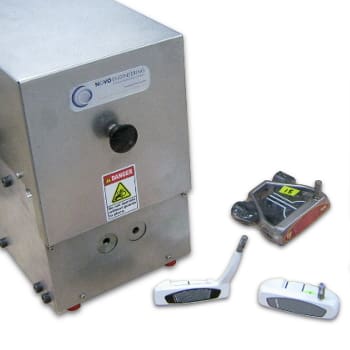
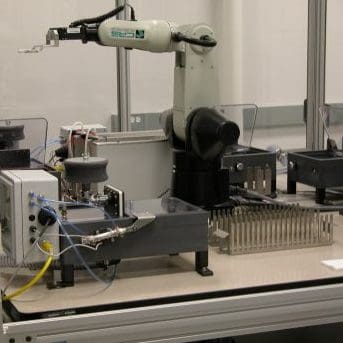
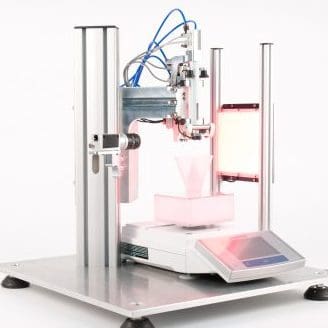
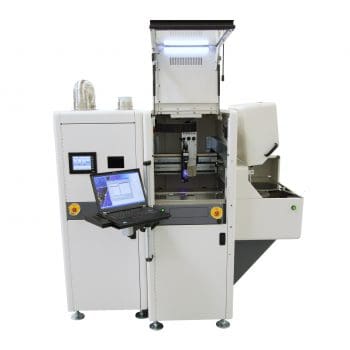
To meet the compressed schedule, NOVO delivered and installed a complete semi-automated test system that included custom software, precision mechanical design, and integrated electromechanical controls.
Software and Controls Development
- NI TestStand and LabVIEW for test automation, sequencing, and data acquisition
- Custom electronics and DAQ hardware to interface with sensors and device features
- Consistent electrical connections to exposed PCB test pads
Mechanical and Electrical Design
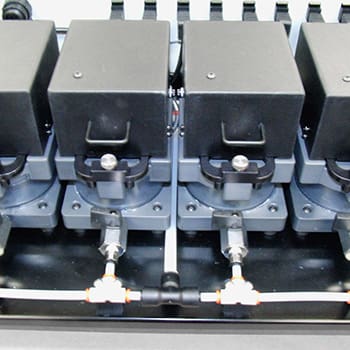
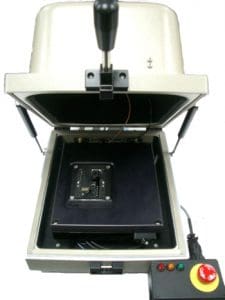
- Articulating mechanisms designed and built in house to apply precise loads, motions, and contacts
- Semi-anechoic enclosure for audio measurements with optimized sensor placement
- Optical alignment methods for LED evaluation despite light distortion through plastic housings
NOVO delivered three unique semi-automated test stations, each designed, fabricated, qualified, and installed within four months. The on-time delivery supported the client’s manufacturing transition plan and ensured that critical quality and safety testing could be performed consistently.
Results and Impact
The completed automated test stations helped the client achieve:
- Reliable, repeatable quality control across multiple assembly stages
- Reduced operator variability
- Faster qualification and manufacturing readiness
- Confidence that critical safety features were accurately verified prior to device release
The project anticipated several trends that now define modern therapeutic device manufacturing:
- Increasing adoption of automated and semi-automated test equipment to enhance repeatability and traceability
- Greater reliance on software driven test frameworks for consistency, regulatory alignment, and digital record keeping
- Integration of electromechanical automation to support higher volume, safety critical devices
- Movement toward fully connected therapeutic ecosystems, which require more sensors, more diagnostics, and more stringent testing
Although this work occurred before connected pumps became mainstream, NOVO’s approach reflected many of the principles now common in smart, sensor rich medical platforms. By building test systems that supported accuracy, data integrity, and reliable sensing performance, NOVO helped set the stage for an industry increasingly driven by automation and digital health integration.
Why NOVO Engineering
NOVO combines deep electromechanical engineering expertise with experience delivering automated test solutions for regulated medical devices. Our team partners closely with clients to define requirements, develop custom systems, and ensure that both the engineering and operational goals of the product are met.
If you are developing a medical device and need automated test equipment to support manufacturing, CONNECT WITH US so we can help you define requirements, design custom systems, and bring your product to market with confidence.